Monday, August 8, 2011

Kuda Lumping Trarditional Dance of Java Islands

Kuda lumping also called braid or jathilan is a traditional Javanese dance center featuring a group of soldiers on horseback. This dance uses a horse made of wicker and bamboo which is cut like the shape of a horse. Matting horse is decorated with colorful paint and fabric. Lumping horse dance scenes usually show only the horsemen, but some performances will also serve lumping horse possessed attractions, immunity, and magical powers, like eating glass and attractions immunity against flogging whip. Jaran braid is part of the dance performances reog. Though this dance came from Java, Indonesia, this dance is also inherited by the Javanese settled in North Sumatra and in some areas outside of Indonesia as in Malaysia.

Lumping horse dance is played with a horse property imitation, made from woven bamboo or braid. None of the historical record can explain the origin of this dance, only verbal history passed down from one generation to the next.

History

That said, lumping horse dance is a form of appreciation and support of the commoners against the cavalry of Prince Diponegoro in the face of Dutch colonizers. There is also a version that says, that lumping horse dance depicting the struggle of Raden Patah, assisted by Sunan Kalijaga, against the Dutch colonialists. Another version states that, this dance tells about the war games led by the Sultan of Mataram forces lane I, King of Mataram, to face the Dutch troops.

Regardless of the origin and historical value, lumping horse dance reflects the spirit of heroism and military aspects of a cavalry or cavalry. This can be seen from the movements rhythmic, dynamic, and aggressive, with the flick of woven bamboo, mimicking the movement like a horse in the midst of war.

Often in lumping horse dance performances, also featured attractions that demonstrate the power of magical supernatural smells, such as the attraction to chew glass, cutting his arm with a machete, burn away, walking on broken glass, and others. Perhaps, this attraction is reflected supernatural powers in the ancient Kingdom of developing in Java environments, and is a non-military aspects that are used to fight the Dutch troops.

Local Variations

In East Java, the art is familiar with the community in some areas, such as Malaysia, Nganjuk, Tulungagung, and other areas. This dance is usually displayed in certain events, such as the welcome guest of honor, and as a thanksgiving, of intent have been granted by the Almighty.

In pementasanya, do not need a special choreography, equipment and supplies as well as Karawitan gamelan. Gamelan to accompany lumping horse dance is quite simple, consisting only of Kendang, Kenong, Gong, and trumpet, the flute to sound shrill. Poems is sung in the accompanying dance, usually containing the appeal that people are always doing good deeds and always remember the Great Creator.

Besides containing the elements of entertainment and religion, traditional arts lumping horse is often also an element of ritual. Since before the show begins, it usually rains a handler will perform the ritual, to maintain the sunny weather remember to keep the show is usually carried out in the open field.

Kuda Lumping Dance performances

In each pagelarannya, lumping horse dance was attended by four fragments of dance that is 2 times Buto dance Lawas, Senterewe dance, and dance Begon Princess.

At Buto Lawas fragments, usually danced by men only and consist of 4 to 6 dancers. Some young dancers horse plaited bamboo and dancing to the music. In this section, Lawas Buto dancers may have possessed or possessed by spirits. The audience was not spared from this phenomenon of possession. Many local residents who witnessed the performances into a trance and danced with the dancers. In the unconscious, they continued to dance with energetic movement and looks compact with the other dancers.

To restore the consciousness of the possessed dancers and spectators, always present in every performance of the progenitor, ie people who have supernatural abilities that its presence can be recognized through the clothes he wore all black. The progenitor of this will give bidders up to the dancers and audience awareness recover.

In the next fragment, male and female dancers joined senterewe bring dance.

In the last fragment, with movements that are more relaxed, six women brought Begon daughter dance, which is a dance cover of a whole series of attractions lumping horse dance.

Sunday, August 7, 2011

Bedaya A sacred dance of Surakarta

A sacred dance of Surakarta Palace Kasunanan Bedaya Pangkur dance was held outside the palace walls. Dance that was more than 200 years dipentas in its original form by the Japanese choreographer at Cultural Park Solo, Central Java. Do not think dance is full of energetic movement as well as modern and contemporary dance. Throughout the dance performances Bedaya Pangkur, Pakubuwono work with a slow IV. Like the dance that was created between the years 1787 to 1820 is a portrait of a romantic poem. Slow motion amid the accompaniment of a portrait pickaxe gising balance between passion and reason of man. Nine dancers are manevestasi in humans as controlling the passions.

Aesthetic value contained in fashion and cosmetology dance bedaya visually linked to the characters found on the dance bedaya. This means that edial bedaya dancers should be selected unless the prnilaian kepenariannya quality, and is still necessary requirements relating to the harmony and precision of a dancer wearing makeup lunkhead ageng and Paes Ageng. This is important because not all dancers are good and appropriate bedaya dancers can wear a dress and makeup dodot ageng Paes Ageng, because there is no requirement of physical conditions that can meet the requirements of the harmony in dress and makeup dodot ageng Paes Ageng. Terkandungdalam aesthetic value fashion and makeup styles of dance bedaya Yogyakarta has close links with the meaning contained in bedaya dance with all the elements contained in it. So if there are evolutionary changes in fashion and make-up dance bedaya it means something to do with the meaning contained in the dance.

Dance performances at the Theatre Arena Bedaya Pangkur Surakarta Cultural Park (TBS) was last staged in 1970. Ironically this is precisely the original dance work choreographed Japan, Michi Tomioka who do research on dance Bedaya Pangkur. "Dance is dance Bedaya Pangkur palace and danced by nine women in the palace and danced by girls" says Michi. According to Michigan, the advantages of this dance is the movement of nine dancers that look similar but not identical. Because each of the dancers perform in accordance with the interpretation of movement and rhythm, rather than dancing with the count as well as in modern dances. No wonder the movement of the dancers looked a little less neat but the compactness of the great dancers in this dance.

Saturday, August 6, 2011

BAELEO THE TRADITIONAL HOUSE MALUKU

Maluku has one of the most interesting and outstanding immediately apparent when you arrive in embarrassment, this building is a building that is different from most of the houses in this Moluccas. The building is usually larger in size, built with materials that are better, and more decorated with ornaments. Therefore, the building usually is also a major markers (landmarks) kampung or village concerned, in addition to mosques or churches. The building is a traditional house that serves as a storage place sacred objects, ceremonial places, and where all citizens gathered to discuss the problems they face. In Maluku, referred to as "Baileo", literally it means "hall". Baileo Maluku use the term "Baileo" as the name suggests, because it is intended as a "hall with" people's organizations and the local indigenous community to discuss various issues they face and seek solutions.

Pamali stone, a large stone where the offerings laid at the door of a building in the Moluccas is a sign that the building is the Hall of Peoples. Baileu or Balai Adat main building is at the Pavilion. Nine columns on the front and rear, and five poles on the left and right is the symbol of Shiva Five, a symbol of fellowship villages in the Moluccas which have existed centuries ago.

In introducing the area featuring buildings and houses Bailem Latu or king's house. Acting as Head sreitek is customary throughout the Moluccas, and was built in 1974 and inaugurated its use on April 17, 1975. Bailem building is the only building that describes the cultural heritage Siwa-five, because that was chosen as the building that can represent the province of Maluku. In addition to these traditional buildings, the pavilion Maluku equipped with two statues of Martha Christina Tiahahu heroine and hero statue Pattimura or Thomas Matulessy, depicting a garden pond Maluku sea, and statues of processing sago.

Bailem building as the original main building no walls and a house on stilts, high above the floor surface. Unisex bailem a cement floor in stone and Bailen is flush with the ground floor. Among the three kinds of Bailen is the most common and most typical is that the floor is built on pilings. Number of poles represents the number of clans in the village. Bailen is not walled contain mean spirits of their ancestors freely in and out of the building. Bailen floor height is being made is so that the position of the dwelling ancestral spirits are higher than the standing of the people in the village. Besides the people will know that the deliberations took place from the outside inward and from bottom to top.

In front of Bailen near the entrance and there beilen pamali that serves as a place of sacrifice and pamali as a storage chamber or a place to put stuff yagn considered sacred ceremony held at the time. Bailen form at Taman Mini Indonesia Indah is the last form of Bailen or a new melambngkan unity or alliance between two major clans in the Moluccas and Pata Pata Siwa Lima. This represents the amount at stake Bailen in the front and rear number 9 is the same as students and left and right side of the same amount to 5 by five. Final word mampunyai Siwa five new meaning is: We all have become a symbol of unity and the Moluccas.

Bailen is a function of deliberation and a meeting place for people with the council as saniri country, the Council of Indigenous and others. So the democratic system has been known by the people since the first five-Siwa. Which may be stored in Bailen form objects that are considered sacred and there is a relationship with the traditional ceremonies. In addition, there is one or deliberation between the people and saniri neheri and indigenous elders.

Friday, August 5, 2011

Betang House West Kalimantan Traditional House

Betang House (call for custom homes in the province of West Kalimantan and Central Kalimantan), a house occupied by the Dayak people. Special Interest found in various parts of Kalimantan, especially in upstream areas which usually becomes the center of the Dayak tribe settlements, where the river is the main transport pathway for the Dayak to perform a variety of mobility of everyday life like going to work to the fields where the fields are usually far from the Dayak tribe settlements, or perform trade activities (the ancient Dayak tribes usually trade using the barter system with the mutual exchange of fields, orchards and livestock).

Houses betang discrete, namely: Stage shapes, elongated. Dayak tribe in particular, the manufacture must be longhouse upstream direction of the sunrise and the sunset next to the downstream direction, as a symbol of hard-work to survive from the sun to grow and go home in the sun outages.

Special Interest forms and large houses will vary in different places. There are houses that reach lengths of Special Interest 150 meters wide and up to 30 meters. Special Interest Generally houses built in the form of a stage with a height of three to five feet off the ground. Special Interest tall building, I expect to avoid flooding during the rainy season that threatened areas upriver in Borneo. Some residential units can have more than one Special Interest houses hanging fruit the size of the household members of the residential community. Each household (family) occupies the chamber (room) that the barriers of a large house the Special Interest, in addition to the general Dayak tribes also have single houses built temporarily to perform agricultural activities, it is because away distances between fields with the settlement.

More than a building for residential Dayak tribe, Special Interest actual house is the heart of the social structure of the life of the Dayak people. Special Interest culture is a reflection of the togetherness in the daily life of the Dayak people. Special Interest in the house is every individual's life in households and communities are systematically arranged by mutual agreement set forth in the customary law. Common security, both from criminal interference or sharing food, the joys and sorrows as well as mobilization of manpower to work the fields. The main value that stands out in his home life is the value of togetherness Special Interest (communalism) among the citizens who inhabit it, regardless of the differences they have. From here we learn that the Dayak tribe is a tribe that respects difference. Appreciate the differences in ethnic Dayak tribe, religion or social background.

But at present too many outsiders (and even Indonesia's own people) think that the Dayak tribe is closed, individual, rude and barbarous. Actually this is a big lie created by the Dutch colonial time period of Indonesia's independence struggle to divide the unity, especially among the Dayak themselves at that upholds the culture of Special Interest home. And a lie is still considered correct until now by those who do not know the correct Dayaks. For example, writing works of the Dutchman named J. Lameijn called Sunrise, which the article is very degrading the Dayak people.

Bad image of the Dayak community in perparah again with the emergence of ethnic riots that occurred in Kalimantan, which in large-scale exposure to out of the country (mainly via internet) regardless of the actual cause of the riots are only looking at based on the massacre that occurred, such as the riots in West Kalimantan (Sambas) and Central Kalimantan (Palangkaraya and Sampit). I myself was in Sampit city during the riots first broke out on February 18, 2001 and two days later I was in Palangkaraya, when I was a junior high school third grade. Based on my views on the ethnic riots in Sampit and Palangkaraya, where here I am not in favor of any tribe, but I prefer to see actual facts on the ground during my stay in Sampit from my childhood to the outbreak of conflict Sampit. Riots are not the result of intellectual figures who want to disrupt a state or feeling jealous because a particular ethnic Dayak tribe is more successful in earning a living in Borneo, but more to the injury of the Dayak community are buried feelings for years due to not appreciate that their culture Special Interest owned by a particular ethnic, until the pain of the injury can not be arrested again by the Dayak community and ultimately lead to the outbreak of the bloody conflict. Certain ethnic groups are supposed to better understand the proverb "Where dipijak earth, where sky upheld", instead of being arrogant and selfish and do not respect the local culture (cultural house that upholds the value of togetherness Special Interest, equal rights, mutual respect, and tolerance).

Now, the house is a dwelling betang Dayak people gradually disappeared in Borneo. Even if the occupants can still be found to no longer make it as a main house, where the family shelter, grow and share their stories with the community. Special Interest stay a distant memory for most of the Dayak. In some places scattered, the house is maintained as a place of Special Interest for the tourists. Call it, for example in Palangkaraya Special Interest there is a house built in the 1990s but rather seen as a monument that is not inhabited. Younger generation of Dayaks are now no longer living at home and grew up Special Interest (including myself). Special Interest is said to only be found in corners, the interior of Borneo without knowing the exact location. The statement of course implies that the home Special Interest only story of the tradition associated with backwardness and underdevelopment of the modern lifestyle.

And now, in the face of modern life are very individualistic, which is only concerned with personal interests, material and full of hypocrisy, cultural masihkan Special Interest houses into order to live together in Borneo or this culture will also disappear as the disappearance of home building Special Interest in Kalimantan. Whatever the answer we only person who can determine it Borneo or the existence of traditional houses in Indonesia it will just disappear because modern life as it is today or whether this house will become mere memories??

Thursday, August 4, 2011

Stage House is a Traditional House of North Sulawesi

Stage house is a traditional house of North Sulawesi, which is actually not a new architectural style. Since the first, the traditional architecture of Indonesia has been implementing the architecture of houses on stilts, houses on stilts is a traditional house, but the principles of houses on stilts can still be used to design a modern home. Stage house has many advantages including the section under 'plong "kind of a big hall can be used for a family gathering areas and private areas of the upper to the family. Houses on stilts are now more modern and simple. Unlike traditional houses in general. Thus, far from the shadow of an ancient impression.

The division of the spaces in the house on stilts in principle the same as regular houses. What distinguishes it is only the bottom only. At home there are usually plenty of space insulation, but the space underneath the stage for home grown minimum wall insulation. Basement (under) can be used for activities that can accommodate as many people hold a social gathering, birthday celebration or celebration of certain holidays. So we do not need to be confused again put the guests despite limited land. Stage house is one approach.

Advantages stage house:

  1. If the ancient people used houses on stilts to avoid wild animals, but today houses the stage serves to separate the two different activities. Only are public or service and the other is private. Public space means that space can be entered by anyone while the private areas only accessible by family members only. The second stage house is a separate zone explicitly.
  2. Underneath is a space that is large enough and flexible, meaning that under it can be used for anything. If there is no guest can be used as family room or children's playroom.
  3. Because there is not much wall insulation so air circulation can be optimized.
  4. Our house also looks wider because it is not much wall insulation.

Wednesday, August 3, 2011

The Sultan of Buton Palace

The Sultan of Buton Palace (called Kamali or Malige) although established only with tangled, without straps or spikes, can stand with the sturdy and majestic above the passwords that are the foundation base. Buton Buton custom home or a building on stilts, and entirely of wood. The building consists of four levels or four floors.

The first floor space larger than the second floor. While the fourth floor is greater than the third floor, so getting to the top vanishingly small or narrow room, but on the fourth floor a little wider. The whole building without using a nail in the making, but rather use wooden pegs or nails. Front pillars consist of 5 pieces lined up back-to eight-row, until the total is 40 units pole. Mullion towering upwards and is the main pillar called Tutumbu which means to grow steadily.

These poles are made of wood and everything wala quadrangular. For ordinary people's houses, poles rounded. Usually these masts peak clipped. By looking at the number of pole beside it be known who or what the status of the owner. Custom homes that have a pole beside the 4 pieces means the house consists of three plots is the home of ordinary people.

Custom house next to the 6-poster will have 5 plots or space, this house is usually owned by the Sultan or house staff member custom Buton sultanate. While the traditional house that has a pole next to the 8 means that the house has seven rooms and is specific to house the Sultan of Buton.

The room arrangement

The arrangement of rooms in the palace is as follows:

  1. The first floor consists of seven plots or room, the room first and second serves as a place to receive guests or members of the courtroom Hadat kingdom of Buton. The third room was divided, the left is used for guest bedroom, and the right of the dining room. The fourth room is also divided by two, serves as a nursery Sultan married. The fifth space as a dining room of the Sultan, or in the guest room, while room sixth and seventh from left to right is used as a plot of girls who've grown Sultan, Sultan rooms and rooms boy mature Sultan.
  2. The second floor is divided into 14 one room, the seven rooms on the right side and 7 rooms on the left side. Each room has its own ladder until there are seven steps to the left and seven right hand stairs, all 14 pieces of the stairs. The function of these rooms are for family guests, as an office, and as a warehouse. Large room that is located next to the front as a family living room of the Sultan, while an even larger as the Hall.
  3. The third floor serves as a place of recreation.
  4. The fourth floor serves as a place for drying. In the next room there is a building Malige buildings such as houses mecil stage, which is used as a kitchen, which is associated with an alley in the stake anyway. In the pavilion was used as an office building the pavilion. In the building there are 2 kinds of ornaments Malige, namely that there are dragons carved on the top ridge of the house, and pineapple fruit carving board that hung on the eaves, and under the front side rooms. As for the ornament contains a very deep meaning, which is carving a dragon is a symbol of the greatness of the kingdom of Buton. While carving pineapple fruit, the pineapple stems that have just grown a pineapple, a symbol that there is only one emperor in the kingdom of Buton. Pineapple flower-crowned, meaning that the right to the royal umbrella dipayungi with only the Sultan of Buton only. Pineapple is a drupe, but the seeds do not grow pineapples from seed, but from rumpunya new shoots arise. This means that the sultanate of Buton not as a legacy bequeathed to children birth to her own child. Pineapple philosophy is symbolized as a sultanate of Buton, Buton and Malige human-like cavity.

Tuesday, August 2, 2011

Balla Lompoa Gowa District Traditional House

A. Overview

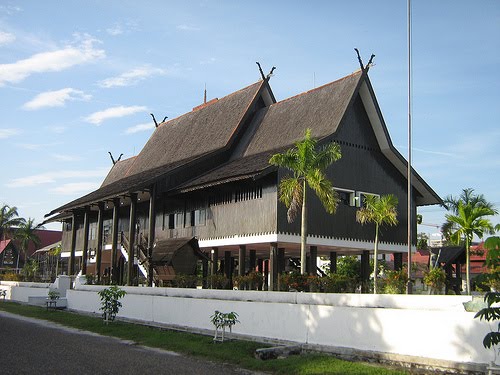
Balla Lompoa Museum is a house on stilts from the palace of Gowa Kingdom which was founded in the reign of King of Gowa-31, I-mangngi Mangngi Matutu Daeng, in 1936. The building stands firmly between the roar of the city Sungguminasa, Gowa-district neighbors in the south of Makassar. Seventy years is not a short time for all the history he has witnessed. In the language of Makassar, Balla Lompoa means a big house or house of greatness. The architecture of the museum is shaped typical Bugis houses, ie houses on stilts, with a ladder as high as more than two feet to get into the patio space. The entire building is made of ironwood or ironwood. The building is located in a one-hectare complex is bordered by high concrete wall. The majority of buildings are made of ironwood is now a museum which became the collection of objects Kingdom of Gowa. While visiting the museum some time ago, I saw things traditional and ancient manuscripts displayed in glass cases.


Building the museum is divided into two parts, the main hall area of ​​60 x 40 meters and a terrace room (reception area) covering 40 x 4.5 meters. Inside the main room there are three chambers, namely: the king's chamber as private rooms, cubicles where the historic objects, and the royal chamber. All three chambers are each measuring 6 x 5 meters. Museum building is also equipped with lots of windows (which are the hallmark of Bugis houses), each measuring 0.5 x 0.5 meters.

This museum serves as a place to store a collection of objects Kingdom of Gowa. Historic objects on display based on the general function of each room in the museum building. At the front of the main building, a map of Indonesia displayed on the right side of the wall. In the main room displayed a family tree starting from the King of the Kingdom of Gowa Gowa I, Tomanurunga in the 13th century, until the last king of Gowa Aididdin Sultan Abdulkadir A. Moch Idjo Karaeng Lalongan (1947-1957). In the main room, there is a place on the throne in a special area in the middle of the room. Some of the tools of war, such as spears and ancient cannons, as well as a lalong sipue umbrella (umbrella that is used when the king's inauguration) are also displayed in this room.

The museum was never restored in 1978-1980. Until now, the local government has allocated $ 25 million per year for the overall maintenance costs.

B. Feature

Museum Balla Lompoa save valuable collection of objects that are not only valuable because of its historic value, but also because the material of manufacture of gold or other precious stones. In this museum there are about 140 royal collection of objects of high value, such as crowns, bracelets, buttons, necklaces, a dagger and other objects are generally made of pure gold and decorated with diamonds, ruby ​​stones, and gems. Among these collections, have an average weight of 700 grams, even up to or more than 1 kilogram. In the king's personal space, there is a cone-shaped crown royal lotus flower (five strands of sepals) weighs 1768 grams which is sprinkled with 250 diamonds gems. In this museum there is also a tatarapang, the dagger of gold weighing 986.5 grams, with a shelf 51 cm and width 13 cm, which was a gift from the Kingdom of Demak. In addition to these precious jewels, there is still a collection of historic objects, such as: 10 pieces of the spear, 7 pieces lontara manuscript, and 2 books of Quran hand-written in 1848.

Balla Lompoa Museum in Jalan Sultan Hasanuddin No.. 48 Sungguminasa, Somba Opu, Gowa regency, South Sulawesi.

D. Access

The museum is located in the City Sungguminasa directly adjacent to the city of Makassar. Travel can be reached by private vehicles and public transport, either four wheels or two wheels.

E. Accommodation and Facilities

Inside the complex, available services guide who will provide information to visitors about the museum itself and everything to do with a collection of historic objects in it.

F.  Secret Lontara

From posters lontara script there are three types of literacy lontara Bugis Makassar. First script-jangang jangang lontara toa, which is a script lontara past. Second, the script lontara sulapa Appa (squares), which is a script that is used lontara common in the community. Finally, the script lontara tell the cleaners, specifically used in the kingdom which is intended to maintain the confidentiality of the kingdom. Lontara toa and lontara tell the cleaners only have a vocal character A. Unlike the lontara sulapa Appa has varied sound, A, I, U, E, O, E. This script was made by Daeng Pamatte (shahbandar Kingdom of Gowa, in tahun1958).

In the king's private room, there are heirlooms that became emblematic of King of Gowa. Among other things, Salokoa, namely makhkota conical king lotus flower (five strands of sepals). It weighs 1768 grams which betabur 250 gem diamonds. Used every inauguration of the king.

Prominent in this museum is a collection of precious objects that are not only valuable because the content of history but also because the materials of manufacture, such as pure gold and other precious stones. One of interest is the tatarapang, kris gold weighing 986.5 grams. Length 51 cm and width 13 cm, which was a gift from the kingdom of Demak.

It is unfortunate, though Balla 'Lompoa is one of the few heritage sites but the preservation of the kingdom of Gowa museum is still fairly minimal. These collections are old enough this is only given in the form of fluorescent lighting, which in addition can not provide the maximum illumination, can also emit heat that can damage the collection. According to A. Kumala Ijo, is very minimal interest in the preservation of a collection of historic objects. Menurtunya, the lack of a clear budget for their maintenance.

Now the big house was still standing strong in the center of Gowa. Iconic toughness Gowa royal past. However, should the cultural sites of South Sulawesi in the past is just a silent witness that will be forgotten, and not developed as a tourist destination that interests the public?

 
Design by Free WordPress Themes | Bloggerized by Lasantha - Premium Blogger Themes | cheap international voip calls